Showing posts with label Analysis. Show all posts

Sunday, 1 March 2020

Permanent commission and command for women officers: Implementation is key to success

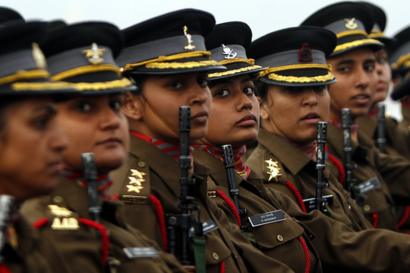
Image result for command women india army
Photo courtesy: BBC

Should women be given a permanent commission in the army? Yes
Should they be given command of their units? Yes, if they qualify and meet the standards, like their male counterparts.

Great development for gender equality, but the devil is in the details.
For this to succeed for everyone, we have to stop treating them like women, but like officers and soldiers! They are as good, if not better than men, they only need a fair chance to prove it.

      Permanent commission and command consideration are complementary - if women are given a permanent commission, they should be automatically eligible for command of their units based on selection parameters, irrespective of gender. This has certain prerequisites that are paramount from recruitment onward. Command of units is a critical role in any army, and it would require the leader to be part of the team in all respects - right from the day he or she wears a uniform.

     Recruit women officers based on vacancies, but also on the same parameters as men.
They must face the same standards of mental tests and physical fitness standards as men during selection. Recruitment of women as officers on compassionate grounds, even as an exception must stop. For example, bending a few rules of commissioning because they're soldiers' widows, or selection as an officer on a sympathy vote must stop. Would a man get a commission in the army with relaxed entry rules for age on compassionate grounds, even if he meets all other criteria? Maybe not!

     Training standards for men and women cadets must be the same. And that begins with integrated training companies and platoons where they live, train, compete in sports and other activities together. All standards applicable to men should be equally applicable to women cadets - the same cross country, 5km run, PT, play football and basketball as teammates with their male counterparts. After all, at the end of it all, each one of them is a potential commanding officer who must lead men and women from the front. The current practice of separate training companies, different duration, different content and standards of training must go. In the beginning, some women may not meet the physical standards, but that expectation needs to be met by them(it should be standard for all who aspire to command), and they will, as time passes. Women must also train with everyone else to understand group dynamics, develop their leadership capabilities, and be able to assume leadership positions by natural selection or nomination during this training. This also helps bust myths about capabilities of women, and helps establish them as leaders among their peers during training.

     Male officers have to establish themselves as leaders in their units right from day one. This starts from the first activity of the day - physical training, where young officers who push their men to attain tougher physical fitness standards establish positive influence over their teams. It is not so much about being physically stronger, but about letting your team know that whatever they do together, you are better than them - therefore you have the moral right to lead. This applies equally to physical fitness, technical and tactical knowledge and application, administration, and knowing and taking care of your team members.
 
     An important aspect to also consider is building camaraderie, which comes to a great extent by sharing hardships together, whether sitting out enemy shelling in a bunker, or sharing tents and toilets with your men as young officers or even doing duty officer assignments without special treatment. People who disappear when the going gets tough are not remembered 'fondly'.  That is why officers who have not spent much time in the field do not have a bond with their men or their peer officers, and probably do not get accepted as true leaders by their teams if they do become commanding officers. This aspect needs to be practiced by women without exception, if they are to be leaders and commanding officers. Of course the activities and experiences that build camaraderie would depend on the arm or service they belong to. For example, in Signals, it may be Signal Centre duties round the clock, or in Air Defence it may be deployment drills at the gun position. In fact, I still remember my course mate from Signals unhappily recounting that a newly commissioned lady officer in his unit was not being assigned signal centre duties in the night, because of which he was on night duty repeatedly. This was soon after women were inducted in 1994, I'm sure that things have changed by now, and women officers do not expect such soft treatment any more!

     People quote numerous anecdotes of women officers participating in and leading difficult operations as examples of their fortitude. Most activities quoted as examples of the 'extraordinary' by women are routine functions that have been done by their male counterparts for ages, like leading convoys, building bridges and roads under difficult conditions, setting up communications etc. If women expect to be at par with men, then they must also realize that 'extraordinary' in military service would not be when compared to other women outside the forces, but as compared to any other officer(whether male or female).

     Lets also start referring to them as officers, not 'lady officers'. Differentiating them as ladies is patently wrong. They are as much ladies as male officers are gentlemen, and need not be reminded of it every time they are addressed!
 
    In any case, once they start getting considered for promotion to colonel and command of units, the promotion process itself would not distinguish between men and women based on their gender(I hope so). The selection process to colonel and brigadier in the Indian Army is confidential and anonymous (I have served in the department that promotes officers, and we went extraordinary lengths to make sure that the process is fair, and the officer is not identified in any way). Therefore, women officers should be considered against the same set of benchmarks used for others in the batch being promoted, with no special favours. Definitely no quotas for command. This is especially important if the quality of commanding officers is to be maintained and they are to be competent leaders. The Supreme Court has noted in its judgement that command is to be given based on criteria established by the armed forces - these should be the same as used for their male counterparts, again, without exception!

     Currently, women serve in services (EME, Ordnance Army Service Corps, JAG, Education) and some supporting arms like Air Defence, Engineers, Signals etc as officers. Not as soldiers. Women could be considered for recruitment into the armed forces as soldiers in these 'departments' as well. If they have been found fit to lead as officers, it is because they can do all those things that the soldiers can, and better - an important factor that determines their acceptance as leaders in units. If women can do it as officers, why can't they do it as soldiers too, especially in roles that do not require combat service in contact with the enemy?

    Thoughts and difference of opinion are welcome.

Colonel Abraham Cherian, Retd

Saturday, 2 July 2016

The Armed Forces get a bad deal from the Pay Commission. Again. Now What?

Everyone in the armed forces is talking about how they've been cheated again in the pay commission and lowered in parity versus the bureaucracy and police forces. Why does this happen again and again in India?

Here's my take on it. Some may find it irreverent (especially to those who see the armed forces as an organization that is way above everything else in the country - almost perfect!), but then, some others may not.

There are conspiracy theories about how the bureaucrats poison the minds of politicians that the Indian Army can stage a coup anytime and so, must always be kept under check. Others say that the armed forces are an epitome of honesty, courage and sacrifice and so bureaucrats are scared because of their own corrupt ways. 

Politicians and ministers (including the prime minister) mouth platitudes about how the armed forces are a pillar of strength to the nation and how much they care about them. That's during election time only. Yet, their money is not where their mouth is. When it comes to compensation, a lower equation with bureaucrats and policemen is considered justifiable.

What does it really mean? Probably that the country does not value the services rendered by the armed forces more than that rendered by its bureaucrats and police forces. I say 'country' because politicians and bureaucrats are a reflection of people's opinions in a democracy. So anyone blaming politicians for the unfair compensation package is indirectly acknowledging that people of the country do not really value their soldiers - they do not really think that soldiers need to be paid as much as policemen or government officials. I say this without any reference to their loyalty and patriotism, (and how people are 'ungrateful' and 'disloyal' to the country if they treat soldiers 'badly') while talking about this whole issue.

Lets try and see this from the economic point of view of supply demand in the market:

Demand. India has not seen a war since 1971. Kargil was more of a blunder and happened because the army was not  doing its job on the LoC well enough (a fact we're not yet ready to accept), in addition to many other factors. The army is huge (1.3 million+ troops and counting) and our generals want even more troops and headquarters every year. Most of the army is involved in quelling discontent (created due to poor governance by the bureaucrats and politicians) or helping the government do its job - essentially standing in for the police or public works and municipal corporations (and recently, for private companies) . No one in the armed forces hierarchy has the courage of conviction to stand up and say that if you use something for a task that it was not meant for, it depreciates in value (more than it would if it was just allowed to exist and do what its supposed to do). But apparently, if there are no wars, you either create wars (an option that India is not capable of) or you use armed forces for whatever else they can be made to do - after all, they're being paid, and for what? (a few of my friends actually asked me this question, betraying their lack of comprehension about how an insurance policy works). 

So reality is, there's  not much (visible) use for the armed forces (and their raison d'être) in India today, like any other country that wants economic development (through low risk of conflict and high political stability, which will positively influence increased investment). Deterrence cannot be measured and therefore does not count towards improving the image of the armed forces (much). Counter Insurgency does not require the army to be deployed, if the police and government were effective. No brownie points for that in the collective conscience of the people (only negative points because some people will definitely identify the army as a repressive arm of the government).  

So overall, medium to low Demand for the armed forces. No one needs them desperately.

Supply. The armed forces want people with low skill sets. Most soldiers are 10th class graduates, who are selected based on physical fitness, more than anything else, and are available in millions across the country. And they're paid more than their counterparts who have equivalent capabilities. I've worked in a recruitment rally where upwards of 40,000 hopefuls landed up for less than a hundred vacancies. 

What about officers? In 2014, more than 240,000 applied for the NDA exam where there are 300 odd vacancies. These applicants are aware of pay and compensation that an armed forces officer is entitled to. And that its not as good an opportunity as the civil and police services. 

People still want to join the armed forces in large numbers, in-spite of knowing the compensation and prospects involved, and the fact that its no longer even close to the status they enjoyed 20, 30 or 40 years ago. But why is there no shortage of applicants? Because the people who would have otherwise wanted to join the forces have moved on (they'll find something better that meets their aspirations and capabilities), and those who still find the armed forces an attractive choice (in relation to their own economic and social conditions) have moved up the line. They will get recruited,because the selection process will adjust itself to ensure a pipeline that replaces those who leave. Either by lowering standards, or better still by creating a new set of standards that caters to the applicant pool (Can you imagine no recruitment because they couldn't find skilled people with the right attributes?!). In any case, there is no shortage of unemployed youth in the country who can be fed into the armed forces really cheaply, whether as officers or soldiers.

So there still is, and will be excess Supply, in-spite of claims that the armed forces are no longer an attractive profession and they're losing their sheen vis a vis other services in the country.

Who is most agitated by the changes in parity with bureaucrats and police forces? Serving and retired officers. Do we hear of a movement among serving or veteran soldiers (who are not officers)? Not really.  Soldiers are participating in the OROP (One Rank One Pension) movement, but its low, compared with the larger population of soldiers and veterans below officer rank in the country. Why?
I would like to imagine that when they compare change in status relative to peers in their society, they're still better placed (compare a retired Naik with his friend who may be working in a small town at a 15,000 salary with no perks or pension), and they look at how their families benefited because they got access to healthcare, canteen facilities and other small benefits that cannot be measured.

Officers who've served twenty years or more (and those who have retired) are most affected, because its their status that's been eroded, in terms of pay and pensions, as well as parity in functioning with their civilian counterparts. The issues are genuine, but the question is,  are they large enough to shake up the system? Maybe not, because those who're serving cannot influence matters effectively, and those retired do not matter either in numbers (mostly officers) or in their capability to influence decisions. Junior officers do not understand the issues completely, and even if they did, their aspirations are already being mostly met.

So what's likely to happen? Status Quo will likely be maintained.

Unless a disruptive change takes place. Like a war. Or veterans joining politics as a homogeneous group and influencing policy in the parliament. Or the government deciding to cut down the armed forces, making it justifiable to pay them well.

Otherwise...

Those serving will continue to do so, those who've retired will continue to agitate and yet accept what they're getting. Because the supply and demand cycle is not likely to be disrupted. There will be a long line of people wanting to join the armed forces- after all they want employment. And the probability of war? Very low as India becomes deeply tied into the world economy and heads towards being a developed country.

Politicians will continue to give lip service to the armed forces. Bureaucrats will continue to rule the country and the armed forces will continue to be eroded in the pecking order (like that hammer you bought when you moved into a new house to drive in the nails, but have no use for anymore. but don't throw away. It just moves from the toolbox to the closet and then into the basement)

This may sound simplistic, but do we need such a huge standing army? Is it possible to pare it down to a realistic size that's manned by well paid, highly motivated officers and men, well equipped and trained to handle conflicts effectively without moving from one bungled(and covered up) operation to another? Maybe. Fact is, this is part of the process of transforming into a developed country that does not have hegemonic aspirations, and by extension, does not need a huge standing army.

But that would mean politicians would have to look at national interest for once, and not their own. Take hard decisions and implement rule of law and good governance by really bringing in good legislation (do we really have to go through new insurgencies that pop up every 5 years and last 20?). Cut down the size of the armed forces, man and train them with the best people (acquired from the 'open market' by paying them at par with any other service in the country, or better - and its possible, if its a smaller, more effective organization), and decide not to use the armed forces to cover up for poor governance and bad diplomacy.

So its a long road to equality for the soldiers....

Wednesday, 6 January 2016

Suggested Strategies for Negotiation on the Siachen Glacier Dispute


This is the second part of the paper on Negotiation and covers only some aspects of the strategy that India could adopt for negotiating the Siachen issue. It DOES NOT cover all aspects of the issue and possible options, mainly because it was limited by length of paper to be submitted...

Obstacles in the Negotiation

Indian Army’s deployment on the Saltoro Ridge.

Demarcation of the Line of Control beyond NJ9842. NJ 9842 (a map coordinate point) lies on the ‘Line of Control’ or LoC between India and Pakistan as per the Simla Agreement in 1972. This point is mentioned in this agreement as the ‘northernmost demarcated point’ beyond which there was no demarcation. For the area north of this coordinate point, the agreement refers to the area as ‘from this point thence north’ without drawing any clear cut line. The segment beyond NJ 9842 was not demarcated on ground by mutual agreement. No movement of any armies was traced during three wars (1947, 1965, 1971) between India and Pakistan, highlighting the fact that no strategic or tactical significance could be ascribed to this area. The basic reason was in-hospitability of terrain and the lack of any means for human beings to live in the area without additional administrative support at great cost and was frequented only by mountaineers and adventurers. The demarcation of the LoC beyond NJ9842 is possible by creating an Uninhabited Zone (UZ) in the area covering Siachen Glacier and the Saltoro Ridge (after vacation by Indian Army). This could include the disputed territory encompassed by the Indian and Pakistani interpretation of the line of Control beyond NJ9842.


Indian Military Withdrawal from the Saltoro Ridge.  An Indian army brigade has been deployed on the Saltoro ridge since the conflict began in 1984. It has secured its positions on the ridgeline at great cost, now called the Actual Ground Position Line (AGPL), and does not want to pull back from these positions unless they are physically demarcated jointly on ground and map by both armies, similar to what was done in previous agreements establishing the CFL and LOC. The army’s view is that future violations must have a reference point. The reason for insisting on demarcation is that once done, the locations of the vacated posts cannot be disputed. The deployment is in inhospitable terrain with high costs to India since 1984. Between 1984 and 2007, 884 Indian soldiers were killed and 13,022 wounded, making for an average of 38 dead and 550 plus wounded every year. India has spent over Rs 8,000 crores ($1,330 million) in the conflict and even though the costs have reduced significantly since the cease fire of 2003, India still spends upwards of Rs 365 crores ($60 million) every year on military operations at Siachen. The primary cause of disconnect with Pakistan on the issue of demilitarization is the sequence of the process. We insist on authentication of the current position of troops as a baseline, while Pakistan insists that Indian army withdraw to pre-1972 positions before talks can begin. Redeployment would imply relocation of troops and equipment to lower heights and withdrawal from the Saltoro Ridge itself, with the sanctity of this redeployment being guaranteed by a suitable mechanism. In addition, army deployment in terms of resources, manpower and expenditure would decrease, permitting this infantry brigade to be deployed elsewhere.

Strategic Importance of Withdrawal and Cost of reoccupying Siachen Glacier. 
i.  The Indian strategic perspective is built on the Sino Pak agreement of 1963 where Pakistan ceded 5000 sq km of Kashmiri territory illegally to China. This led to the belief that Pakistan could potentially collude with China, and control of the Siachen area might provide Pakistan with a route to capture the city of Leh and the Ladakh region  with a flanking offensive. Conventional wisdom of the time included scenarios in which China might have joined this offensive. However, this idea was generated in the early 1980s, almost twenty years after Pakistan signed the agreement, indicating that the changing international political and diplomatic equation might have prompted this belief, leading to the Indian occupation of Saltoro Ridge in 1984. The Government of India did not feel the need to occupy Siachen Glacier immediately after the Sino Pak agreement was signed in 1963, as this threat was not felt at the time. It appears that evidence of ‘cartographic aggression’ by Pakistan forced India’s military response in the 1980s. In the present international environment, a ‘joint’ war by Pakistan and China is an unlikely event, and so is a war initiated by Pakistan alone against India in the mountainous Himalayan region. 
ii. However, a ‘Kargil (1999)’ like limited attack by Pakistan cannot be ruled out, especially with the inherent instability of their civilian government and Pakistani army’s dominance of diplomacy and international strategy. If such an event should occur, India would be forced to launch military operations to retake these positions at great cost. To prevent this kind of a misadventure by Pakistan, India would be well advised to consider withdrawal only if sanctity of the demilitarized zone is guaranteed by a neutral agency that can impose its will on Pakistan.

Pakistan’s aim to achieve military parity with India. It is in Pakistan’s interest to keep the Indian army deployed in counter insurgency and other localized conflicts. Siachen is one such conflict where uncertainty in the situation has resulted in India catering for deployment and maintenance of military reserves. This helps Pakistan achieve ‘local’ military parity in a theater of war by tying down Indian Army in penny packets, should a large scale conflict take place. It would be in the Indian government’s interest to deny this advantage to Pakistan by overcoming the Siachen dispute so that no military deployment is necessary to guard our interest. India should also negotiate demilitarization to free up military resources for application elsewhere, should the need arise. Ideally, overcoming all disputes that result in peace time military deployment would afford India an advantage that Pakistan seeks to undermine strategically.

Third party mediation. 

India has traditionally been against third party mediation on any issue with Pakistan. This is a result of the Simla Agreement of 1972, which states “..That the two countries are resolved to settle their differences by peaceful means through bilateral negotiations or by any other peaceful means mutually agreed upon between them...”. In view of the changed international and regional political balance where US and USSR are no longer supporting either side, India could consider mediation by a neutral agency that is acceptable to both sides. Third party mediation has multiple advantages for the Siachen conflict:

Break the Stalemate. India and Pakistan have had thirteen rounds of talks from 1986 till 2010 with no real progress on a solution. These talks have been bilateral and India has not agreed to third party mediation on any aspect of its relations with Pakistan since 1972. Since no progress on addressing issues including Siachen Glacier conflict has taken place, it would be worthwhile to invite neutral parties to mediate and come to a workable solution that considers both parties’ interests.

Face Saving. Both India and Pakistan have invested time money, resources and political capital in the Siachen issue. Giving up any of the stated positions on Siachen could be seen as a loss of face by the people of India and may affect the prospects of the political party in power in India. A third party mediator can bring in new ideas and address difficult positions on either side, making it easier for them to transfer the ‘blame’ for a seemingly generous concession on any aspect. 

Resources. Third party mediation may bring in additional resources available to such agencies. International organizations can also deploy resources available to them as part of actions to enforce a solution. Since this is a conflict involving demarcation of boundary, deployment of the United Nations Observer teams, for instance would assist in monitoring a brokered peace. UN Military Observer Group in India and Pakistan (UNMOGIP) has been deployed in Kashmir since 1948, and such a task could ideally be extended to the UN.

Power Asymmetry between India and Pakistan. 

Differential between India and Pakistan in terms of aggregate indicators are approximately: population: 6:1; size: 4:1; GDP: 8.5:1; defense expenditures: 6:1; and total number of active forces: 2:1. Only in per capita income is the ratio closer. Since the mid-1950s Pakistan has enjoyed intermittent alliance support from the United States, and since the 1960s there has been a de facto alliance between Pakistan and China. These alliance relationships have offered “borrowed power” to Islamabad and enabled it to reduce the power asymmetry with India. While United States has given aid during its war on terror with the intention of using Pakistan for its larger strategic goals, Pakistan’s main goal has been to increase its capabilities in relation to India and reduce the power disparity with India. Although in the South Asian context India is larger in physical size, GDP and overall military capability, it is not overwhelmingly preponderant in the conflict’s key theater or on the international border. The near parity in troop disposition, especially in the Kashmir theater, gives Pakistan several advantages in limited, asymmetric wars. Partly due to its status-quo orientation, and partly due to constraints in terms of capability and terrain, the Indian strategy in Kashmir has been in general, defensive and reactive, while the Pakistani strategy has been one of offensive-defensive. The basic tenet of Pakistan’s strategy throughout the conflict has been to take the military initiative at crucial junctures, especially by relying on surprise. Since India-Pakistan rivalry encompasses both territorial conflict and geopolitical positioning, a further widening of the gap in capabilities between the defender and the challenger may be essential for a full rapprochement to occur. This may take at least two decades of sustained economic and military growth on India's part, as well as the significant re-positioning of the great powers (China and the United States) with regard to the rivals.

India’s Best Alternative to Negotiated Agreement. 
i. Our main contention is the alignment of the Line of Control beyond NJ 9842 under present conditions, even if the larger Kashmir issue is not resolved. India would not like to agree to an arrangement where we are seen as giving up our position on Siachen Glacier. There are issues of public perception about loss of territory which will dominate any negotiated settlement. Overall, India has a very strong BATNA due to our dominant military and economic position, in-spite of Pakistan’s attempts to balance the power asymmetry. India should continue to hold entrenched positions (which are militarily stronger) on the Saltoro range in the absence of a negotiated settlement. Due to the ceasefire in effect since 2003, combat related casualties have become minimal. Over a period of time, India has advanced its medical support resources deployed in the area, and weather and terrain related casualties have dropped. The advantage of India’s BATNA is that it does not involve any specific and incremental military, diplomatic or strategic action on its part. India’s present position is justifiable in international forums. 
ii. Pakistan does not have a BATNA that is as effective or viable. It can continue to hold its positions on the lower slopes of the Saltoro Ridge; alternatively, it can launch military offensives in other areas to force India to divert its military resources there. But these tactics can only achieve a stalemate that does not lead to settlement of issues. In addition, Pakistan is not in a position to attempt such military endeavors at present due to preoccupation with operations in support of American military operations in Afghanistan, as well as economic and military weakness due to prolonged internal turmoil. 

Strategy for Negotiation

Engagement with Pakistani Army, the Pakistani political establishment and China as stakeholders.

Engagement with the Pakistani Army and political establishment. Historically, Pakistani army as had a dominant role in shaping Pakistan’s strategic and political thinking and has a strong hold on diplomatic and security machinery. The position of the NSA in Pakistan has been held by the military for long, except during 2007-08 and 2012. The military in Pakistan is once again in the process of strengthening its grip on the civilian control, as reports in the media suggest. It is a well-known fact that the army in Pakistan is an extra-constitutional authority and power center that has the capability to intervene and dislodge the civilian government, as well as overrule policy positions of the civilian government. In the past, a military coup by the army in Pakistan has led to long periods of military rule. The military also has a major say in framing Pakistani policies with regard to India. Many democratic countries have engaged with military dictators and unelected governments to achieve their national interests, including the United States. In the case of Siachen Glacier, which is a strategic issue being played out by both militaries, it is in India’s interest to acknowledge the role played by Pakistani army in their foreign and defense policies. Engagement with the Pakistani army has the advantage of being able to incorporate a demilitarization plan that the army in Pakistan agrees to and is compelled to honor, if it were to be part of the negotiations. Unlike the Indian army, which is under the firm control of, and will act on any settlement that is negotiated by the Indian government, there is a possibility that the Pakistani army does not follow through with the commitments expected of such a settlement by the civilian government. What is of greater concern to us is that at some point in the near future, another military government in Pakistan could negate an agreement on Siachen and revert to hostilities and unilateral military action. An additional advantage of engaging with the army in Pakistan is that the civilian government would be able to work towards a conclusive agreement where all Pakistani power players are represented. It could lead to a solution where the civilian government would not be subject to a ‘blame game’ by the military with accusations of having ‘sold out’ to India and assist the civilian government in managing domestic politics

Engagement with China. Demarcation of Pakistan occupied territory with China in 1963 was negotiated with a view to resolve border issues between the two countries. A similar problem existed on the Indian side of Kashmir where the borders of Kashmir with China had not been demarcated on ground. Consequent to Kashmir’s accession to India, we feel that Pakistan, which is illegally occupying Kashmir since 1947 does not have the right to give away territory that does not belong to it. However, this action was an incident of realpolitik by Pakistan to resolve issues with China as well as gain their support against India. China on its part has signed a conditional agreement that depends on the outcome of the larger Kashmir issue. India has a border dispute with China that also involves the eastern areas of Arunachal Pradesh. India lays claims to Arunachal Pradesh and is controlling the region, while China has occupied Aksai Chin (the area adjoining Siachen Glacier) and has built a highway connecting with Sinkiang Province. Although China is not a direct party to the Siachen conflict, it is a stakeholder in the larger border issue in the region and must be incorporated in the negotiations, since demarcation of territories is based on historic perceptions held by the erstwhile kingdom of Kashmir vis a vis Chinese authority in the region at the time. The Chinese government must be engaged with a view to gain a convergence of differing interests on the Siachen Glacier resolution. This would subsequently help India in resolving its larger border disputes with China, namely in the Aksai Chin and Arunachal Pradesh regions through tradeoffs across these issues of differing priorities.

Establishment of a Demilitarized Zone (DMZ) at the Siachen Glacier and Interpretation of the Line of Control. 
Establishment of a DMZ would be preceded by delimitation of the LoC beyond NJ9842. Both India and Pakistan have proposed delimitation of the Line of Control beyond NJ9842. Past talks have been deadlocked over India’s insistence that the AGPL be demarcated on the ground as well as on maps, and Pakistan’s insistence that Indian troops must withdraw to pre-1972 positions before any meaningful discussions could take place. “India’s approach towards a final settlement should be based on demilitarization of limited well defined, mutually agreed prescribed area”. 

India is in a far stronger economic and military position than earlier and can propose a unilateral declaration of its positions through a note verbale or a non-paper rather than insisting on physical verification of its positions as a prerequisite to demilitarization. Effort and resources required to reoccupy defensive positions held currently will be magnified, should withdrawal be followed by a need to redeploy. We are concerned about recognition of our ‘fall back’ positions, should talks or the process of demilitarization fail. This could be achieved by unilaterally publishing maps showing our dispositions and making them available to international organizations and the public. India could utilize multiple techniques to drive negotiations forward in a favorable direction on acceptance of these maps through joint demarcation exercises.

Following a declaration of positions physically occupied by India, a move to sequentially withdraw from Saltoro Ridge in a time bound manner in conjunction with Pakistani withdrawal would ensure that both sides take confidence building measures, which are visible on ground and can be verified. This could be combined with a caveat in the demilitarization agreement that India would retain the right to use military force at a point of its own choosing in the case of any future occupation of these positions by Pakistan[8]. Such a clause would caution Pakistan to reassess the cost of unilaterally attempting to occupy the areas vacated by the Indian Army. Anchoring options around declaration of Indian positions along with a concrete plan for withdrawal would help in guiding negotiations towards a conclusive solution. However, all withdrawals need to be part of a demilitarization plan that is agreed to jointly by both countries. 

The defining aspect of DMZs is the establishment of a physical area (a “zone”) that separates opposing military forces. Exact demarcation of the DMZ should be carried out by a joint working group that can consider the interests of both sides. Involving a neutral third party mediator like a UN organization (independent of the larger Kashmir issue) to assist in the management of the DMZ may be considered. Advantages of third party mediation have already been discussed earlier in this paper. Agreeing to mediation would also provide India the leverage to extract concessions during negotiations over the larger Kashmir issue. 

Demilitarization could proceed in two phases: Monitoring and Verification. Cooperative monitoring of the demilitarization process between the two countries would help to negate trust issues regarding the process. The disengagement process must be monitored to ensure that troops on both sides have withdrawn to mutually agreed positions; their logistics and operational bases have been dismantled and removed in such a way that they cannot be reoccupied in a short time frame. Bilateral monitoring implies that both countries can monitor the area through their own national technical means, within internationally established norms. Verification of the process as well as long term verification by onsite inspections and remote monitoring to prevent redeployment also needs to be established, preferably through neutral international organizations like UNMOGIP. Sharing of information at various levels between Indian and Pakistani armies deployed in the area would be essential for monitoring and verification process. Given the past history of Pakistani army acting independent of the government, it would be advisable to maintain alternate means of information gathering about possible reoccupation of the demilitarized zone. This is all the more important, since logistic buildup for military operations in mountains is time consuming and the party that takes the initiative will gain.

_______________________________________

[1] Why Siachen Matters to India’, Nitin A Gokhale (accessed  December4, 2015) available from http://mujournal.mewaruniversity.in/JIR%202-2/8.pdf
[3] Paul, T. V. 2006. “Why has the India-Pakistan rivalry been so enduring? Power asymmetry and an intractable conflict.”  Security Studies 15 (4): 600-30.
[4]Pakistan Army now has seat at negotiating table with India’  (Accessed December 13, 2015), available from
[5] “Demilitarization of the Siachen Conflict Zone: Concepts for Implementation and Monitoring”, Sandia Report SAND2007-5670, (September 2007): 19.


Thursday, 24 December 2015

Conflict Analysis: The Siachen Glacier Dispute

Also read: The Story of My Family

Here is a modified version of a paper written by me recently for a course on the 'Process of International Negotiations'


Conflict Definition

Siachen Glacier lies at the Northern extremities of Kashmir and its borders with China. Due to extreme climatic and terrain conditions in the Himalayan Mountains, this area was unexplored and not demarcated until recent times. Consequent to the 1971 war between India and Pakistan, the existing Cease Fire Line (CFL) of 1949 was converted to a ‘Line of Control’ through signing of the ‘Simla Agreement' between India and Pakistan; however, it was demarcated only up to NJ 9842, a boundary pillar beyond which the terrain was considered too harsh to be of any relevance at the time. Both sides agreed on the Line of Control upto NJ 9842, and “thence north to the glaciers.” Since the line is not specified beyond NJ 9842, both countries have interpreted it differently.


SIACHEN GLACIER SHOWING THE PHYSICAL TERRAIN, OVERLAPPING BOUNDARY CLAIMS,
AND DE FACTO BORDERS OF INDIA, PAKISTAN AND CHINA


Pakistan draws a straight line in a northeasterly direction from NJ 9842 up to the Karakoram pass on its boundary with China. India instead draws a north-northwest line from NJ 9842 along the watershed line of the Saltoro range, a southern offshoot of the Karakoram range.

The present conflict has its genesis in Pakistan allowing mountaineering expeditions into the area in the 1970s and 80s. India felt this to be a form of ‘Cartographic Aggression’. To stake its claim over the territory, India launched a military operation in April 1984 to occupy the western ridges of the Siachen Glacier valley. In response, Pakistan launched a number of repeated offensives on Indian positions of the ridgeline. Both both armies continue to be deployed facing each other at heights of 4,000 to 6,000 meters above sea level. Both sides have suffered a large number of casualties among their soldiers, more so on the Indian side due to their positions being higher in altitude and on more difficult terrain.

The territorial situation as it presently stands is that Pakistan considers the Siachen Glacier Complex to be at the eastern extremity of Baltistan—a Northern Area that is unambiguously under its control. India, by contrast, maintains that the Siachen Glacier is the western boundary of the Nubra Sub-Division of the Ladakh District of Jammu and Kashmir—a territory which has been part of India's administrative jurisdiction since the accession of that state to the Union of India in 1947.

Significant Parties To The Conflict


The main parties to the conflict (who are or may be “at the negotiation table”);
a. India
b. Pakistan

Major factions or players within each party;

India
a. Government of India.
b. Indian Army. Though Indian army is a stakeholder in the conflict, it is under control of the Govt of India and may have a minor role to play in the negotiations.

Pakistan
a. Government of Pakistan.
b. Pakistan Army. Within Pakistan, the army is an extra constitutional authority and has a say in political and diplomatic issues. Strategic interests of Pakistan are controlled by the army and it has the ability to disrupt negotiations.


China is an additional party with a stake in the conflict. It is affected due to its 1963 agreement with Pakistan where territories that previously belonged to Kashmir were exchanged. It can be a potential spoiler because of the influence it has over Pakistan. 

Third parties who may be attempting to facilitate resolution of the conflict are:
a. United Nations. It has limited influence over the conflict since it has not been able to enforce its resolution of 1949 with either party.
b. United States. Though the US has attempted to mediate a peace and withdrawal of both forces, it has not been successful, and both India as well as Pakistan have criticized the role US attempted to play.
c. Track II negotiators from India and Pakistan. A recent development where track II negotiators from both countries attempted to find a neutral solution to the problem.


Perspectives Of The Parties


Issues in the conflict

India
a. Mutual distrust between India and Pakistan has risen to new heights after the nuclear test of May, 1998. Both India and Pakistan face what the superpowers have faced since the early fifties: the risk of a conventional conflict escalating to a nuclear one.

b. Consequent to the 1949 cease fire with Pakistan and the Line of Control being established between the two countries, India is sensitive to further loss of what it considers its own territory. The perceived loss of areas to the North of NJ 9842, though not defined at the beginning of the conflict as Indian territory are nevertheless considered Indian. On the contrary, Pakistan stakes a claim to this area because it was undefined even after the wars of 1947 and 1971.

c. Interpretation of the Cease Fire Line (CFL) consequent to the 1949 war and the Line of Control after the 1971 war with Pakistan.

d. Admission of international mountaineering expeditions into the area by Pakistan is considered an act of covert extension of territorial claims. India regarded Pakistani encouragement of mountaineers into the non-demarcated area as a calculated ploy to gain control of Siachen.

e. Pakistan’s claim to Siachen received support from prestigious international mapping agencies who had endorsed it as being Pakistani territory on their maps. India called this ‘cartographic aggression’ by Pakistan.

Pakistan
a. The geo-strategic nature of Pakistani aims at securing control of the Siachen Glacier complex to secure for themselves a common border with China, with a view to seek reassurance of Chinese support against India in the event of general hostilities.

b. Siachen Glacier area falls under the Pakistan administered sector of the disputed state of Jammu and Kashmir, called Federally Administered Northern Areas and must be restored to its control till an internationally supervised plebiscite is concluded in the state, as decided after the ceasefire agreement of 1949.

c. Based on the interpretation of the Line of Control as described in the 1972 Simla Agreement and its clauses on maintaining status quo, Pakistan considers Indian occupation of the Saltoro range illegal. 

d. Pakistan is willing to bilaterally negotiate with India as it considers Siachen Glacier disputed territory, especially since it falls outside the demarcated Line of Control. It was willing to accept Siachen as a no man’s land, till India unilaterally occupied the Saltoro range.

Positions

India has taken the position that all talks related to Siachen Glacier and other issues concerned with boundary be held under the 1972 Simla Agreement, signed after the 1971 war. Pakistan has in the past, opted for airing the matter in international fora, such as the UN and the Organization of Islamic Conference (OIC) and not limit resolution to the bilateral level.

Consequent to Pakistan’s border agreement with China in 1963 and construction of the Karakoram highway, India was concerned that a collusive Pakistan and China could jointly plan to annex Indian held territory in Kashmir. India does not recognize this agreement because it believes that Kashmir has been illegally occupied by Pakistan. 

India’s stand is that delineation of boundaries be carried out along the watershed in accordance with the accepted international watershed principle. India insists that it should extend along the Saltoro ridge-line connecting point NJ 9842 with the Sia La, Sherpa Kangri, and on to K2, merging with the international boundary agreed in the 1963 Sino-Pak Border Agreement. By stating its stand based on the watershed principle, India hopes to apply this position to its territorial dispute with China as well. 

India has outlined its six proposals on the Siachen Glacier dispute during multiple talks with Pakistan:

i. A cessation of 'cartographic aggression' by Pakistan (that is, of its unilateral attempts to extend the LOC from its agreed terminus at map reference point NJ 9842 to the Karakoram Pass of the border with China);

ii. Establishment of a demilitarized zone (DMZ) at the Siachen Glacier;

iii. Exchange between India and Pakistan of authenticated maps showing present military dispositions on the ground;

iv. Delimitation by India and Pakistan of a line from map reference point NJ 9842 northwards to the border with China 'based on ground realities' [AGPL];

v. Formulation of ground rules to govern future military operations in the area;

vi. Redeployment of Indian and Pakistani forces to mutually agreed positions.

Though Pakistan supports Kashmiri self-determination through a UN-sponsored plebiscite, it has effectively annexed the Northern Areas, which are contiguous to the Siachen Glacier. It now considers these areas disputed territories that India does not have a right to occupy. The Pakistani team, led by Foreign Secretary Syed Ijlai Zaidi, claimed during the first round of talks in 1986 that India's induction of its forces on the Glacier was a violation of the Simla Agreement. Pakistan's formal terms have been twofold during many rounds of talks with India:

i. Deployment of Indian and Pakistani forces to mutually agreed positions held at the time the ceasefire was declared in 1971.

ii. Delimitation of an extension of the LOC beyond map reference point NJ 9842.

Interests

India considers Jammu and Kashmir to be an integral part of the country by the accession instrument, and Pakistan as an aggressor. Pakistan disregards the accession of Jammu and Kashmir to India, which it considers to be fraudulent and inappropriate to an area dominated by a majority Muslim population “It is not just military confrontations and threats of war that ensue—indeed, the fear and pride related to Kashmir and the subsequent ill will compels both countries to embark upon further programs of hate and adopt new inflammatory dimensions to an already troubled relationship”. Islamabad considers the Siachen Glacier and the Northern Areas absolutely vital to the security of Pakistan- “Indian occupation of the Siachen Glacier would gain desired proximity to the Karakoram Highway—the focus of a joint Soviet/Afghan and Indian pincer movement”.

Under the Sino-Pak border agreement, the government of Pakistan relinquished claims to over 4,000 square kilometers of territory, in return for China’s cession to Pakistan of over 1,300 square kilometers of territory actually administered by China. Pakistan was not the sovereign authority empowered to make a final settlement with China, which is still pending the outcome of the Kashmir question. An Indian withdrawal from Siachen would validate the agreement between Pakistan and China. Gaining control of the Siachen Glacier from the geostrategic viewpoint is critical to allow Pakistan a common border with China, which could be used in the event of hostilities with India to seek Chinese military cooperation and support on ground. 

Pakistan's stated ambition has been to achieve military parity with India. By keeping the Indian army occupied in localized conflicts, it hoped to negate the advantage of superior strength, both quantitatively and qualitatively by India.

Application of the watershed principle to its disputed Himalayan borders with China is critical to Indian strategic interests. Loss of the Siachen Glacier would have placed India in a much weaker position vis-a-vis China regarding negotiations on outstanding border issues along the border with China as it would mean applying different yardsticks for similar boundary issues. 

India does not accept a third party intervention in the conflict and repeatedly asserts that all negotiations and problem solving be carried out under the Simla Agreement of 1972. However, Pakistan wants the issue of Kashmir and Siachen Glacier to be settled through international mediation or intervention, which is in contradiction with the Indian interest in a bilateral settlement.

Alternatives

India is likely to continue to hold its entrenched positions (which are militarily stronger) on the Saltoro range in the absence of a negotiated settlement. The region has seen a ceasefire in effect since 2003, as a result of which combat related casualties no longer occur. Over a period of time, India has advanced its medical support resources deployed in the area and weather and terrain related casualties have dropped. Though the costs in money terms of maintaining the army at such altitudes is prohibitively high, India is capable of continuing to do so. 

India’s main contention is the alignment of the Line of Control beyond NJ 9842 under the present condition, even if the larger Kashmir issue is not resolved. Therefore it is likely to walk away from any negotiation that suggests realigning the AGPL based on Pakistan’s interpretation, as there are issues of public perception about loss of territory which will dominate any negotiated settlement. Overall, India has a very strong Best Alternative To Negotiated Settlement (BATNA) due to its dominant military and economic position. 

Pakistan could continue to hold its positions, as a ceasefire is in effect and its army is in any case subject to lesser casualties due to terrain and weather. This is an attractive BATNA for Pakistan as it does not involve any additional military, political or diplomatic commitments.

One option for Pakistan is to launch an offensive in the Siachen Glacier area to dislodge Indian Army from the Saltoro range. However, this is not a very attractive BATNA as the Indian armed forces are numerically and qualitatively superior and are occupying dominating positions. Pakistan will not be able to support the war economically, in addition to being subject to sanctions from international agencies for being the aggressor.

Pakistan could launch military operations elsewhere to capture Indian held territory and bargain for withdrawal of Indian forces from Siachen Glacier. This was attempted by Pakistan under General Parvez Musharraf in 1999, but India was able to divert its armed forces from elsewhere and evict Pakistani forces. This BATNA has been attempted and was unsuccessful, therefore is no longer a suitable option.

Pakistan and China could jointly launch military operations to capture Siachen. However, in the present international order, a joint war by two countries on India may draw in others and would in any case be viewed as unwarranted aggression, especially by China as it is not a direct party to the conflict. Overall, Pakistan has a set of weak BATNAs that limit the amount of influence that can be applied on India to negotiate a demilitarization of the Glacier. 


Communication And Relationship-Building


Historically, India and Pakistan have a hostile relationship since independence in 1947. Minor skirmishes on territorial issues have led to three full scale wars in 1947, 1965 and 1971. India and Pakistan have had eight rounds of talks on the Siachen issue from 1986 to 1998. However, India’s insistence that the present deployment (the AGPL) be demarcated has been countered by Pakistan with the argument that India must withdraw to pre 1972 positions before any meaningful talks can commence. Pakistan holds the view that when the two armies withdraw their forces from the zone of conflict and agree to refrain from re-establishing any military presence in it, the original positions will become irrelevant.

Both countries successfully disengaged their forces from the Chumik Glacier, which is located quite close to Siachen, through negotiations at the field commander level. This indicates that it is possible to work out negotiated settlement at the local level without prejudice to the remaining issues. On 25 November 2003, Pakistan proposed an informal cease-fire along the LOC including the Siachen conflict zone, and India accepted the proposal.

A composite dialogue process was initiated between India and Pakistan in 2004 to address parallel, but separately eight issues that affect relations between the two countries, Siachen Glacier being one of them. The Siachen issue has been separated from the larger Kashmir issue, creating a hope that it may be resolved independent of the related issues. Pakistan sees agreements in trade and other areas as a springboard for resolution of the Kashmir issue, but India sees trade and other cooperation independent of Kashmir, since it believes that Kashmir is an inalienable part of India.

The joint statement of 12 June 2012 following the India-Pakistan defense secretary level Siachen talks as part of the composite dialogue process said: “Both sides reaffirmed their resolve to make serious, sustained and result oriented efforts for seeking an amicable resolution of Siachen. It was agreed to continue dialogue on Siachen in keeping with the desire of the leaders of both countries for early resolution of all outstanding issues.” However, no progress on ground has taken place beyond these talks.

Criteria Of Legitimacy


Since the Siachen issue is related to demarcation and interpretation of boundary, as well as ownership of territory, the following agreements and UN resolutions may be interpreted to arrive at a resolution:

a. The Simla Agreement of 1972 between India and Pakistan.

b. The UN Commission for India and Pakistan resolution of 13 August 1948.

c. The UN Commission for India and Pakistan resolution of 5 January 1949.

The UN resolution of 13 August 1948 states at Part II A (1) that Pakistan agrees to withdraw from Kashmir before a plebiscite may be held. Therefore it may appear that Pakistan has to vacate its occupation of the state of Jammu and Kashmir and has no claim to the Siachen Glacier. 

The Simla Agreement states that “Pending the final settlement of any of the problems between the two countries, neither side shall unilaterally alter the situation and both shall prevent the organization, assistance or encouragement of any acts detrimental to the maintenance of peaceful and harmonious relations.” India would be a violator since it unilaterally deployed its troops on the Siachen Glacier in April 1984 in contradiction to this agreement. 

_________________________________________________________________________________
References:
[1] The Simla Agreement, (Accessed October 28, 2015), available from http://www.operationspaix.net/DATA/DOCUMENT/6771~v~Agreement_Between_the_Government_of_India_and_the_Government_of_the_Islamic_Republic_of_Pakistan_on_Bilateral_Relations__Simla_Agreement_.pdf.

[2] Dr. Ishtiaq Ahmad Siachen, “A By-Product of the Kashmir Dispute and a Catalyst for its Resolution,” Pakistan Journal of History & Culture, Vol.XXVII/2, 2006.

[3] Raspal S. Khosa, The Siachen Glacier dispute: Imbroglio on the roof of the world, Contemporary South Asia, 8:2, 1999, 187-209.

[4] Gulshan Majeed, South Asian Security Compulsions: A Historical Analysis of India-Pakistan Relations, Journal of Political Studies, Vol. 20, Issue - 2, 2013, 219:232

[5] Resolution adopted by the United Nations Commission for India and Pakistan on 5 January 1949 (Accessed October 28, 2015), available from http://www.claudearpi.net/maintenance/uploaded_pics/19490105ResolutionforCeasefire.pdf.

[6] Siachen: A By-Product of the Kashmir Dispute and a Catalyst for its Resolution fight (Accessed October 23, 2015), available from http://www.nihcr.edu.pk/latest_english_journal/siachen_a_bi-product_of_kashmir_dr_ishtiaq.pdf .

[7] Ashraf, Sajjad. "India-Pakistan Relations: Common Ground and Points of Discord." ECSSR (Abu Dhabi).Emirates Lecture Series.88, 2011: 0_1,1,35,37-58.

[8] “Demilitarization of the Siachen Conflict Zone: Concepts for Implementation and Monitoring”, Sandia Report SAND2007-5670, (September 2007): 19.

[9] Is there any hope for India and Pakistan? (accessed on 28 October 2015), available from http://foreignpolicy.com/2014/09/02/is-there-any-hope-for-india-pakistan-relations/

[10]Sumona Dasgupta, “ Kashmir and the India Pakistan Dialogue process”, RSIS working paper No 29 (21 May 2015): 11.

[11] Resolution adopted by the United Nations Commission for India and Pakistan on 13 August 1948 (Accessed October 28, 2015), available from https://www.mtholyoke.edu/acad/intrel/uncom1.htm.

[12] Resolution adopted by the United Nations Commission for India and Pakistan on 5 January 1949.

[13]Ravi Baghel, Marcus Nüsser, “Securing the heights: The vertical dimension of the Siachen conflict between India and Pakistan in the Eastern Karakoram,” Political Geography, Volume 48, September 2015, Pages 24-36

[14] Siachen dispute: India and Pakistan’s glacial fight (Accessed October 23, 2015), available from http://defence.pk/threads/siachen-dispute-india-and-pakistan%E2%80%99s-glacial-fight.309100/

Sunday, 5 April 2015

AFT Judgement : What's Ailing the Army?

So many people have voiced their opinion on the Armed Forces Tribunal ruling on the distribution of AVSC vacancies and the way forward, that I thought of writing once again on the subject. The issue of allotment of vacancies is only the symptom of sickness and the disease needs to be treated, not the symptoms. I feel that these are some of the issues that need to be addressed.

The seriously flawed system of appraisals in the army needs to be overhauled. Inspite of reaching senior ranks through a stringent selection system of numerous promotion boards, many senior officers are manipulative, displaying partisanship and pettiness. The future doesn't seem to be too bright either, since these qualities are being demonstrated by many junior officers as well, the only difference being that their effects are much lesser. Working for one's own regiment / arm or service and favoritism seems to be the order of the day. One of the complaints is that officers with a series of outstanding reports from certain arms  do not get promoted due to lack of vacancies. This may not necessarily mean that they're actually outstanding. It could mean that reporting is inflated in that arm, since gentlemen cadets across the spectrum of merit and calibre are allotted to each arm and service. Reporting by reviewing officers (formation commanders or other senior appointments) is supposed to moderate confidential reports initiated by subordinate commanders. But in many cases, it is partisan, with officers of some arms being graded high due to a false sense of camaraderie and regimental spirit that creeps into reporting. A comparison of average Annual Confidential Report marks received by officers across arms and services would indicate so. It cannot be that the average ASC or EME officer is poorer in performance as compared to the average infantry, mechanized or artillery officer when graded on the same scale (within his own corps), since officers of all capabilities were distributed more or less uniformly on commissioning. I wonder why officers with character flaws slip through a system of confidential reports that 'measures' leadership traits and integrity, and rise to high positions of command? And I believe that this is so across all arms and services, not just in the arm that seems to be the current villain!

Formation commanders must give up their regimental affiliations in matters affecting the army as a whole. There seems to be no  sense of camaraderie between officers of various arms and services in-spite of a common training academy and other a training institutions. Junior officers are mostly brought up on rhetoric that one's own arm is 'best' as compared to other arms, while the focus should be on how a well organised, trained and coordinated army can fight and win a war with minimum casualties. Obviously, this will happen when everyone does his job, since it contributes to success of the operation. Senior ranks must stop looking at gobbling up the pie for themselves and their extended 'families'(corps, regiment, unit, coterie etc). Debate on promotional vacancies has been raging around who gained and who lost, not around good of the organisation. The newly thought up concept of 'Colonel Commandants for life' is just an excuse to provide perks to generals even after retirement and must stop. There are adequate appointments in the army to look after regimental requirements (and these shouldn't exist in the first place!) It does not make sense for a Corps or Army Commander to also be a 'Colonel' of his regiment. Its just encouraging him to be parochial, and this fact has been proved in the instant case, since senior officers entrusted with ensuring a healthy and competent officer cadre have failed because of parochialism.

The status of general cadre being given to officers based on arm/ service in which they were commissioned should be reviewed at the highest level. The question is not whether artillery officers should be part of the general cadre or whether an ASC officer can command an infantry brigade. No one should be inducted into general cadre without proving himself in his own as well as at least one more arm or service through cross attachment and responsibility. Infantry and mechanised forces officers included. Tougher standards of professionalism must be the filter, and not pedigree. Entry into general cadre should not be a one way ticket to leadership on being commissioned. The army has to find ways to identify outstanding officers, and not lower standards to include officers from a favored arm or service into an elite group.

Education and awareness levels of most officers (including senior officers) is limited to studies that they themselves order and direct based on their own perceptions, or studies that they have worked on earlier in junior ranks. No research or military paper that originates in a lower formation ever reaches the higher levels without tinkering by all and sundry up the chain, and claim staking at each successive level that its their own. Most 'researched' studies are not even  read by formation commanders, who read only the summary and watch a PowerPoint presentation, giving directions to modify it based on their own thought process. This vicious cycle must be broken by acknowledging ownership of research or study, even if it has originated at the lowest level. The tendency to modify everything based on the perceived likes of the next senior must stop and original thought must be encouraged.

Duration of command of formations should be increased so that commanders remain in touch with ground realities. A divisional or corps commander is in the seat for less than a year and barely sees his policies being implemented. For example, I personally drafted training instructions for one general, who signed it and was posted out immediately thereafter. The next divisional commander had to implement his ideas and thought process on a different set of training instructions which had been issued barely a month ago. Most commanders hurriedly implement their personal ideas as policies and leave before the effects are seen. Short term high visibility activities are therefore the preferred method of execution,  to prove within this period that they're good enough for the next rank . You can't run a marathon over 100 metres. So the formation is left running 100 metre sprints. Repeatedly. The most damaging fallout of all this is that there is a disconnect between generals and junior officers(and troops), which is magnified by sycophant staff officers who do not convey the reality.(You can either talk reality or impress the formation commander in 11 months)

It will not be enough to just redistribute vacancies proportionally or even convince the courts that the policy in vogue is fair and good for the organisation. That would be like using a painkiller for cancer. We need to introspect at the highest level on the issues that are repeatedly being thrown up and find long term solutions in a holistic manner.

These views are based on my experiences and are my personal opinions.

Friday, 27 March 2015

On Police - Military Cooperation...

Well, I thought, let me write something different this time. We've all interacted with the police at various times during our lifetime, and I'll list two of my interactions that stood out. You be the judge.

Gujjar Agitation, Rajasthan, 2007.
I was the commander ( a major) of one of the army columns sent to assist the civil administration when the Gujjars (caste / tribe in Rajasthan) decided to block the National Highway between Jaipur and Agra for their perceived grievances. Among others, one of the districts where life had practically ground to a halt was 'Karauli', which we had to stabilize. Well, we reached the district headquarters after a five hour drive from Alwar, one officer, three JCOs(warrant officers) and 75 men in  our army trucks and jeeps. All along, we found groups of (senior) police officers huddled inside various buildings trying to figure out a way to break the deadlock (just the previous day, an attempt to forcibly remove the 30,000 odd Gujjars from the national highway had been unsuccessful, with many a policeman beaten up by the mob), We found the district SP (Superintendent of Police) holed up in his office and looking distinctly scared. So I told him that we should go around the district and decide on an action plan to get things back to normal. He refused and said that it was unsafe to go out. I did manage to convince him a couple of days later, and he moved out, with a truck-full each of policemen ahead of, and behind his car. During one of our patrols, when I entered a police station in a fairly big town in the district, I found a DIG of police (Deputy Inspector General, equivalent to an army Brigadier ) sitting on the Inspector's chair. The moment he saw me, he said with relief  "..thank God you're here. The police station is under grave threat. I've deployed four companies of policemen to protect us. We(I) need protection so why don't you deploy your army column around the station? The people won't mess with you.." I told him that we were there to restore peace, and not to protect the police in the riot affected district, but he was not convinced...

Counter Insurgency Operations, Baramula District, 2011
This was during the period of intense civil agitation in the Kashmir valley when I was commanding my regiment. We were responsible to run the convoy from Srinagar to one of the outlying towns, 90 km away. One day, my column commander, a major, called me on my phone and told me that the convoy had been stopped by a posse of policemen near Baramula and a DSP(deputy Superintendant of Police, equivalent to a Captain) had placed his men on the road, blocking the army vehicles. Stopping a military convoy on the road is unsafe - a static convoy of vehicles in a hostile area with threat of stand-off attacks is vulnerable and is practically a dead duck. The police officer said that some hired trucks in the convoy were suspected to be carrying illegal timber and he needed to check them. On hearing this, I told my officer to move the convoy immediately, grab the police officer by his collar and shove him into the major's Jeep, and take him to Srinagar. The trucks could then be safely checked inside the convoy ground. I also called my brigade commander and GOC(General Officer Commanding) and informed them. (We subsequently didn't have to carry the police officer to Srinagar, and next day, the local DIG apologized to the General for trying to stop the convoy.)

 I wonder why police officers in this country behave the way they do? And if this is the way they behave with the army, I wonder what they do with the public!!

Thursday, 5 March 2015

AFT Quashes Army’s promotion policy for Colonels: My take on it All

         I thought that I must write down my thoughts on the whole issue, especially having been at the right time and place when the controversy was being created. I do not intend to give the juicy details of who said and did what, but focus on the issues. Let me keep it short and simple.

The Issue

750 odd Colonel's vacancies were released by the government sometime in 2008(or was it 2006?). In 2004/05, the selection board for promotion from Major to Lt Col was done away with. Everyone would become Lt Col on completion of 13 years service. But the vacancies for Colonels did not increase much in 2004, making the pyramid steeper at that level.
Here is an illustration:

                      Majors                                          Lt Col's  Vacs                        Colonel's Vacs
                                                                                                                            (No change)

2003                100         (50% promoted)                    50       (50% promoted)        25

So 25 out of 50 Lt Cols would become Colonel.

2007                100         (timescale promotion)           100    (25% promoted)         25

All figures are illustrative only. Don't get emotional about them.Please!

A similar number of officers were becoming Colonel, but dissatisfaction perceived was much higher. (Only 25 out of 100!What is this Army coming to!)

Now, additional vacancies were released to ease the pain. It could have been divided proportionally among all arms and services or pro rata vacancies (All of them have gone through the same kind of shit, only in different settings). So giving everyone a 50% chance to become Colonel and to command a unit seemed fair.
Well, the powers that be decided that only some should get this windfall; field allowance for serving in difficult areas is not enough, it must be enhanced with liberal promotions. Irrespective of contribution (or lack of it..) to the organisation during these 'difficult' tenures.


So what are the advantages of keeping promotion approvals at or below 50%:

We don't dilute standards. If you're not in the top half of your batch, do you really deserve to command your unit? Even if you're in Infantry or Artillery or Armoured Corps? And still call yourself a professional army?!!

There is no disparity between arms and services. And there shouldn't be. (At least upto Colonels. But more on that later.) Remember, we're all on the same side (On a serious note, all officers compete within their corps till Colonel, so we should not compare life in Infantry with life in ASC or EME) For instance, an EME Lt Col may be responsible for technical readiness of all guns in an arty brigade, while an artillery Lt Col may be a battery commander looking after only his 6 guns. So who deserves to get promoted more than the other? We don't know. But can they be compared? NO. So an EME or ASC (or Engineer / Mechanised Infantry) guy should have a similar chance of becoming a Colonel in competition with his batch mates. Lets say 50% for all arms, to keep it simple.

Everyone can't be given a 70% chance of promotion. If you do have a hundred vacancies, you can only divide them 50-50, or 70-30. Not 60-50. So if someone decides to take 70, it had better be you. Otherwise you end up at the wrong end of a promotion board result.

And we really don't want to be like the IPS or IAS where everyone has rank, but no one seems to be doing anything much.

Command of formations is for elites with relevant experience. Period. The key word is 'elite'. Command of formations is not for officers from 'the arm' or 'arms'. So why are we hellbent on giving it to 'wrong' officers from the 'right' arm / regiment/ battalion? Work the statistics. ( maybe someone at HDMC can work out the probability of an officer in the 50-60% bracket from the top making it to Major General as a project or thesis!)

So if we agree on the basics, we can move on. But when some enlightened souls bring in a 'Command Exit' model (whatever in the hell is that!!) without consulting those in the business of managing officers' promotions  on a daily basis, all hell is bound to break loose. Even if the 'yes men' keep denying it to their bosses. By the way, if someone who remained awake during maths lectures at NDA went through that spreadsheet, it would probably take him 5 minutes to punch holes in it. That long if he was 'slow on the uptake'.

These are the questions that have been going around:

Which arm/service stood to gain by this tweak? Everyone seems to know.
Who were the power players? We don't know that openly. The concerned officers (and very senior ones, as well as those who've now become very senior) displayed lack of honesty and moral courage.
Was there no one who objected? Not many who gained from it all. And those who didn't object - they don't matter in any case.

So what happened due to this hijacking of 'good order and military discipline' in the army?

A large percentage of officers from certain arms became Colonel (and brigadier, and major general...). Full marks, AVSC aim has been met. We've improved the 'satisfaction level' (for some, but everyone cannot be satisfied)

A large percentage of officers from certain some arms became commanding officers at a young age.(Full marks, AVSC aim has been met for some, yet again)

And what about the incidents of failure of command among those very arms? Most incidents have not been recorded or even acknowledged as that.("After all, he's from that arm and done so well. This should not affect his Higher Command prospects..lets help him out..") Halo Effect.  Is there a relation between lower age of command WITH lower standards of selection and these incidents? (CDM and HDMC student officers now have more ideas for studies)

"So what if some officers didn't become Colonel in spite of being in the top 40% of their batch? They had a 'ball' during the last twenty years, didn't they? All those guys who barely scraped through JC, command of their sub units, and were not even in the top 50% will make up for these disgruntled elements who're psc and outstanding subunit commanders (but in the wrong corps) .."
etc. etc.

So what is the issue?
Is it that vacancies need to be redistributed? Yes, in the immediate future, in the most practical way possible. And it'll take 5 years. Because this has been moving in a different direction for the last 5 years.
But more than that, our commanders must work towards regaining the faith of all officers. From all arms and services. Even if these officers can't do shit about all this. 
Because they perceive a wrong doing by their commanders(including those who stood by and watched things happen).

How do we ensure that this doesn't happen again? We need to understand that right or wrong is more important than 'convenient or inconvenient'. Incidentally, what is right is more often than not, inconvenient. At all levels. The boss is not always right. We need to groom our officers to stand up for what is right, and not follow the superior, or 'regimental izzat'  BLINDLY. .... the list is long (should the CO report and take action on an incident of attempted rape by one of his unit jawans? or sort it out internally?)

      Units are not families, and officers are not to be 'taken care of' like a spoilt child. A military unit is a fighting machine ( even an ASC company (Tk tptr) Type C is, believe me) and so officers have to be held accountable. An officer must uphold the highest standards of leadership (including fairness towards his command and comrades, which seems to have been missing here) even when his peers and boss say that its okay to be otherwise.

"This is alright, we heard it all. But what practical things can you do?"

Put your dissent on file. Don't put up 'draft' notings.

Don't allow loopholes in policy letters and procedures.  Make them well.

Do not implement a weak policy for 'flexibility'. Make someone high up sign a 'waiver' if he wants to favour someone - and watch his hands shake!

add your own....

The link for an article on the AFT judgement is here http://indianexpress.com/article/india/india-others/aft-quashes-armys-promotion-policy-for-colonels/

These are my opinions and not statement of facts. And I am open to changing them on seeing evidence indicating otherwise.